Body care is getting the skincare treatment: what it means for the formula (40-second video)
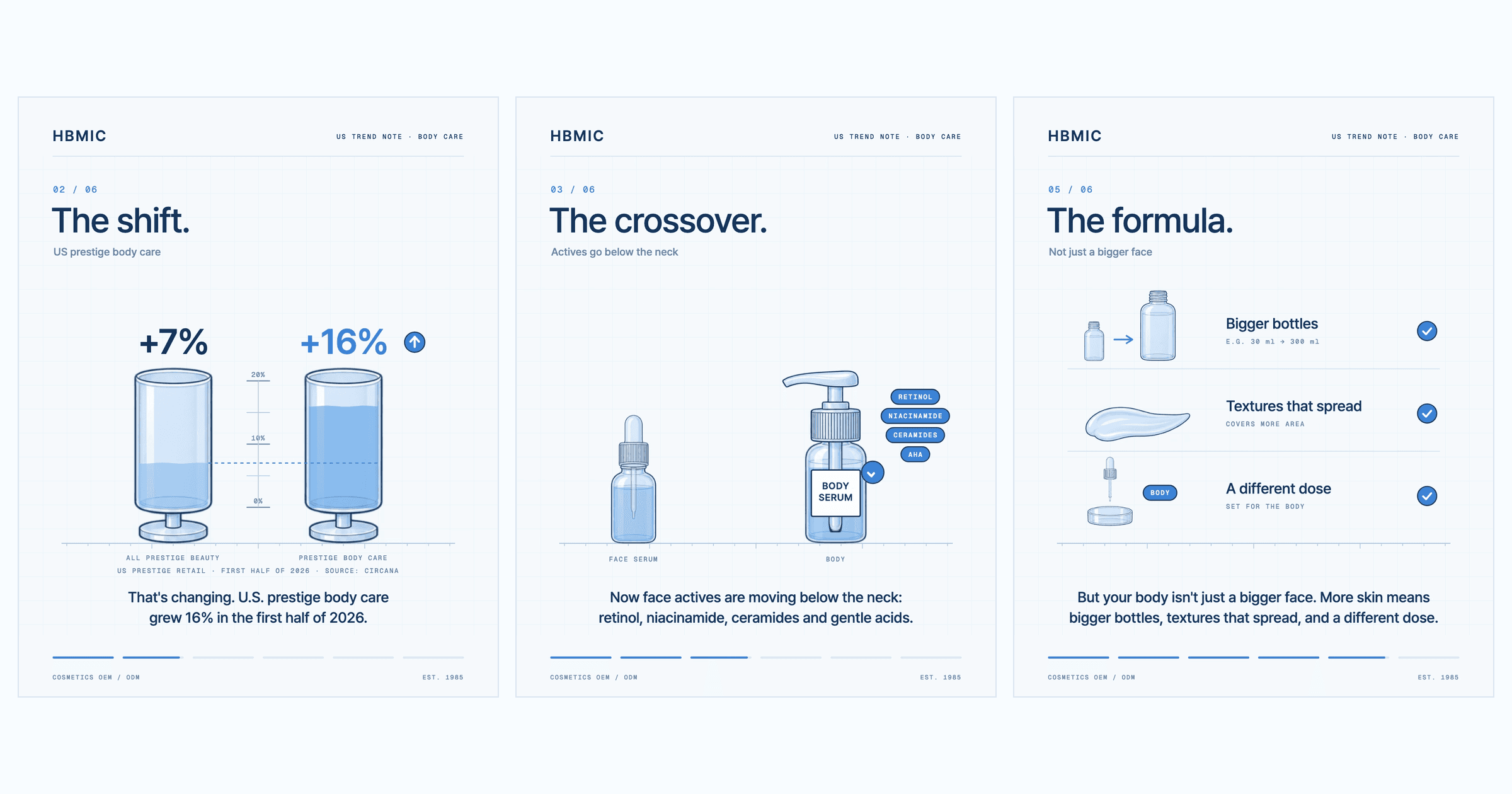
Face care has had serums, acids and peptides for years, while the rest of the body mostly got a lotion. That gap is closing. In the first half of 2026, U.S. prestige body care sales rose 16%, more than twice the 7% growth of prestige beauty overall. The 40-second video below shows the shift, and the rest of this article covers what it means when you develop a body care product.
The numbers: body care is outgrowing prestige beauty
According to Circana's first-half 2026 report on U.S. beauty retail, published on August 11, 2026, prestige beauty sales rose 7% to $17.1 billion. Skincare was the fastest-growing prestige category at +9%, and its growth was led by body care and sun care: body care sales rose 16%, with strong gains in body cleansers, body lotions and deodorants, and sun care rose 19%.
Circana links skincare's growth to consumers' focus on whole-body wellness, preventative treatments and daily rituals. In other words, the habits people built around their face are extending to the rest of their skin.
Face actives are moving below the neck
The ingredients behind the shift are the ones face care made familiar: retinol, niacinamide, ceramides, and gentle acids such as lactic and glycolic acid. In body products they target concerns like rough texture, dryness and uneven-looking tone on the arms, legs and back.
One bottle becomes a routine
Body care is starting to be built the way face care is: an exfoliating wash, an active serum, and a lotion or cream to lock in moisture. For a brand, that means planning a line of two or three products designed to be used together, rather than a single standalone lotion.
Why a body formula isn't just a bigger face
Filling a face formula into a bigger bottle doesn't make a body product. Four things change when the same active has to cover the whole body.
Dose. A body product covers far more skin than a face product, so more of it is absorbed in total, and regulators set limits with that in mind. Under Regulation (EU) 2024/996, retinol and its esters (retinyl acetate and retinyl palmitate) are capped at 0.05% retinol equivalent in body lotion, against 0.3% in other leave-on and rinse-off products, and must carry the warning “Contains vitamin A. Consider your daily intake before use.” The limits apply to new products placed on the EU market since November 1, 2025. Acids call for the same care: the U.S. FDA recommends a sun-sensitivity warning on cosmetics containing alpha hydroxy acids (AHAs), and Korea requires caution statements on products containing more than 0.5% AHA.
Texture. A body product has to spread quickly over a large area, absorb before clothes go on, and leave no sticky film. A serum texture that feels right on the face can feel heavy or tacky on the legs or back.
Packaging. A face serum often comes in 30 ml; a body product is usually several times that size and is used over a longer period after opening. Pumps and tubes that limit air exposure matter more for actives that are sensitive to light and air, and compatibility between the content and its container has to be tested at the actual size.
Claims. In Korea, a product that claims to brighten skin or improve wrinkles is a functional cosmetic and needs a filing with the Ministry of Food and Drug Safety (MFDS), whether it is for the face or the body. If a body serum is positioned on tone with niacinamide, or on wrinkle care with retinol, decide the claim and the filing route at the formulation stage.
Planning a body care line
Start from one concern, such as rough skin on the arms or dryness on the legs, and choose the active and a body-level dose around it. Decide whether the product stands alone or belongs to a wash, serum and lotion routine, and settle the size and dispenser early, because both affect the formula. If the product is for export, tell us the target market at the start: as the retinol limits show, the same ingredient can carry a different limit depending on where it is sold and what kind of product it is in.
Our MOQ is based on a minimum batch of 130 kg, so a large body size reaches the minimum in fewer units than a small face serum. Once we receive your brief, a lead researcher is assigned within 3 business days, and the first sample ships in about 5 days.
HBMIC Research is written by the lab team at HBMIC, a cosmetics OEM/ODM manufacturer in Daegu, Korea, founded in 1985 under the former Korean name 한방미인화장품.